
Symalen Pipe Standards: Standard Sizes and Custom Solutions
Symalen pipes are designed around standardized conduit dimensions, making it easier to combine the pipe with commonly available fittings, junction boxes, elbows and fixing systems. But what happens when a standard dimension is not enough?
Why Are Standard Symalen Pipe Dimensions Important?
One of the main advantages of a standardized conduit system is compatibility.
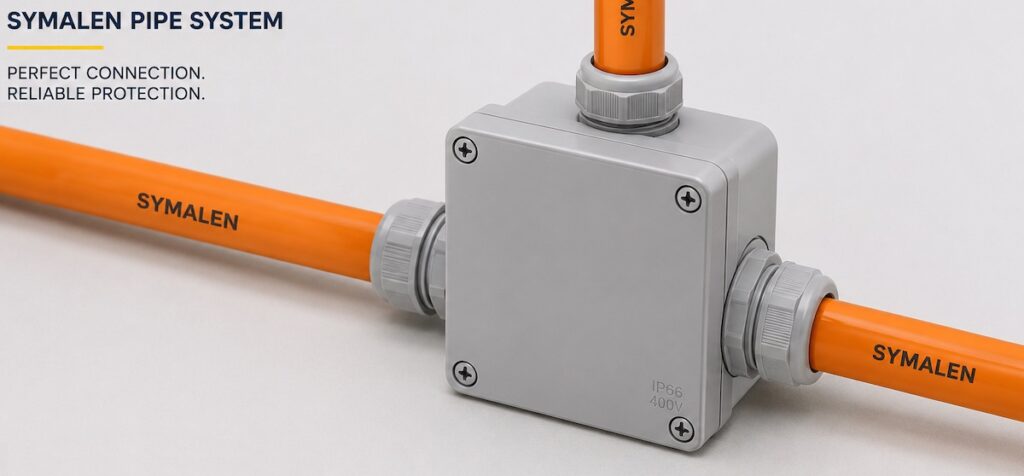
A pipe is rarely used as a standalone product. In real installations, it normally forms part of a complete system that may include:
- elbows,
- junction boxes,
- connectors,
- couplings,
- cable entry components,
- fixing clips,
- mounting accessories,
- adapters and other conduit fittings.
For this reason, the outside diameter, inside diameter, wall thickness and mechanical properties of the pipe all influence the compatibility of the complete installation.
Standardized dimensions make procurement and installation easier because installers can select fittings that are already available on the market instead of requiring a completely customized component for every project.
The IEC 61386 family of standards provides requirements for conduit systems used for cable management. Different parts of the standard cover different types of conduit systems, including pliable and rigid systems.
A pipe is only one part of the system
The real advantage of standardized Symalen dimensions is not simply the pipe itself. It is the possibility of combining the pipe with a wider range of commercially available installation components.
Standard Dimensions Mean Easier Installation
For installers, engineers and distributors, standardized dimensions provide an important practical advantage.
If a Symalen pipe corresponds to a commonly used nominal size, it can be much easier to integrate into an existing installation concept.
You can reduce the need for:
- specially manufactured fittings,
- project-specific adapters,
- custom fixing solutions,
- additional tooling,
- installation modifications.
This is particularly important in construction, electrical installation and industrial applications where the conduit is part of a larger installation system.
The exact compatibility, however, should always be checked for the selected pipe and fitting combination. Nominal diameter alone does not guarantee compatibility: outside diameter, inside diameter, tolerances, wall thickness and the geometry of the fitting can all be relevant.
What If You Need a Non-Standard Symalen Pipe?
Standard dimensions cover a large proportion of applications, but not every engineering project can be solved with an off-the-shelf pipe.
This is where custom extrusion becomes valuable.
As an extrusion manufacturer, ST Plastics can develop Symalen-type pipe solutions with customized dimensions or wall thicknesses according to the technical requirements of the application.
Possible development parameters can include:
- customized outside diameter,
- customized inside diameter,
- modified wall thickness,
- specific dimensional tolerances,
- application-specific mechanical properties,
- customized lengths,
- material or formulation adjustments where technically appropriate.
This allows the pipe to be optimized for a specific installation rather than forcing the application to adapt to an existing standard product.
When the standard size is not enough
ST Plastics can develop customized pipe dimensions and wall thicknesses for applications where standard Symalen dimensions do not provide the required performance.
Diameter
Customized outside and inside diameters.
Wall thickness
Modified wall thickness for application-specific requirements.
Tolerance
Dimensions can be developed around the required manufacturing tolerance.
Application
The geometry can be optimized for the intended installation.
Custom Wall Thickness Is a Development – Not Simply a Different Setting
There is an important technical consideration when changing the wall thickness of a flexible conduit.
A pipe’s wall thickness directly influences its mechanical behaviour.
Increasing or reducing the wall thickness can affect:
- flexibility,
- bending force,
- minimum bending radius,
- resistance to deformation,
- dimensional stability,
- behaviour during installation,
- compatibility with existing fittings.
Therefore, a custom wall thickness cannot simply be treated as a cosmetic modification.
A pipe with a different wall thickness may not behave exactly like the standard version.
For example, it may require a larger bending radius, may become more difficult to bend around tight corners, or may be more susceptible to local deformation during installation.
In some cases, the customized pipe may even kink or collapse sooner than the standard construction if the geometry and material properties are not properly balanced.
This is why custom Symalen pipe development should be treated as an engineering development project, rather than simply a new size in a catalogue.
Custom wall thickness requires validation
Changing the wall thickness can change the flexibility and bending behaviour of the pipe. A customized version therefore needs to be tested and validated for the intended application before series production.
Why Does Custom Symalen Development Take Time?
Developing a customized extrusion is more than changing a dimension in a drawing.
Depending on the requested modification, development can involve:
- Reviewing the application requirements.
- Defining the required dimensions.
- Evaluating the material and wall thickness.
- Designing or modifying the extrusion tooling.
- Producing development samples.
- Measuring the resulting dimensions.
- Testing flexibility and bending behaviour.
- Checking compatibility with fittings.
- Optimizing the extrusion process.
- Approving the final construction for series production.
This development process is important because the objective is not simply to produce a pipe with a different diameter.
The objective is to produce a pipe that works reliably in the intended application.
From requirement to custom pipe
Requirement
Application and dimensional requirements.
Design
Geometry and wall thickness development.
Prototype
Tooling and first development samples.
Testing
Flexibility, dimensions and application testing.
Production
Validated construction for series production.
Why Costs More?
A customized pipe can provide significant advantages when a standard product does not meet the requirements. However, development involves additional engineering and manufacturing work.
For the manufacturer, this means additional:
- engineering time,
- tooling work,
- machine setup,
- development material,
- prototype production,
- testing and validation.
For the customer, this means an additional development investment.
The important point is that these costs are not simply an extra charge for a “special size”. They are part of creating a new extrusion solution that has to perform reliably.
Development takes time from the manufacturer and investment from the customer.
The result, however, can be a pipe specifically optimized for a particular application, production process or installation requirement.
Standard when possible. Custom when necessary.
ST Plastics combines standardized conduit concepts with the flexibility of custom extrusion manufacturing. If an existing Symalen dimension does not meet your requirements, we can evaluate the technical feasibility of a customized diameter or wall thickness.
CUSTOM PIPE DEVELOPMENTStandard Symalen Pipes or a Custom Extrusion?
The right solution depends on the application.
Choose a standard dimension when:
- existing fittings are important,
- installation components are already specified,
- standard bending behaviour is required,
- the application can be solved with an existing product,
- fast availability is a priority.
Consider a custom dimension when:
- the required diameter is not commercially available,
- a special wall thickness is required,
- the pipe must fit a specific component,
- the installation requires a different mechanical behaviour,
- an existing standard pipe does not provide the required performance.
The most important question is not simply “Can you manufacture this diameter?”
It is:
“Can this diameter and wall construction deliver the required performance in the intended application?”
That is the question that should drive custom pipe development.
Conclusion
Standardized Symalen pipe dimensions provide an important advantage: they make it easier to build a complete conduit system around commercially available fittings and installation components.
However, standard dimensions cannot cover every application.
When a project requires a different diameter or wall thickness, ST Plastics can develop a customized extrusion solution. The key is to understand that changing the geometry can also change the pipe’s flexibility, bending radius and mechanical behaviour.
That is why custom Symalen pipe development is an engineering process involving design, tooling, prototyping and validation.
Standard dimensions provide compatibility. Custom extrusion provides flexibility in design. The right solution is the one that delivers the required performance in the real application.
About ST Plastics
ST Plastics specializes in custom plastic extrusion and the development of tubes and profiles for industrial and technical applications. From standard conduit concepts to application-specific geometries, the company can support projects from initial technical requirements through prototype development and series production.
 English (UK)
  Slovenčina
  Deutsch
  Magyar
  Français
  Čeština
  Slovenščina
  Hrvatski
  Nederlands