Extrusion or Injection Molding? Which Plastic Manufacturing Process Is Right for Your Product?
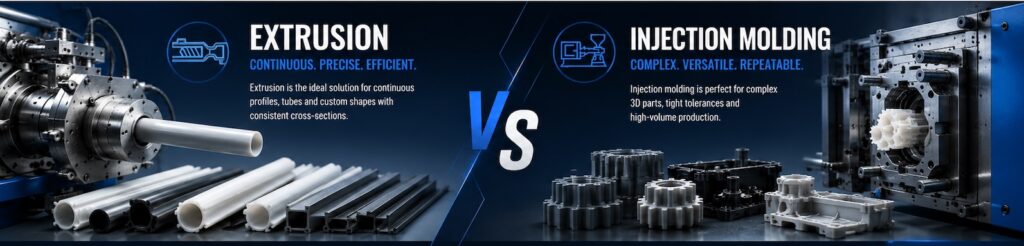
Extrusion or
Injection Molding?
Which plastic manufacturing process is right for your product? Understand the key differences between plastic extrusion and injection molding — and learn when each technology makes the most sense.
Constant cross-section
Complex 3D geometry
Two technologies. Two very different manufacturing principles.
Both plastic extrusion and injection molding transform thermoplastic materials into finished products. The fundamental difference lies in how the material is shaped.
Extrusion creates a continuous product with a defined cross-section. Injection molding creates individual components by injecting molten plastic into a mold.
The right choice therefore depends primarily on the product geometry, dimensions, production volume and functional requirements.
Extrusion vs Injection Molding
The two technologies may use similar thermoplastic materials, but their production principles are fundamentally different.
Plastic Extrusion
Plastic granules are melted inside an extruder and continuously pushed through a specially designed die.
The die determines the cross-sectional geometry of the product. The profile is then cooled, calibrated and cut or wound to the required length.
- Continuous production
- Constant cross-section
- Ideal for tubes and profiles
- Custom extrusion dies
- Long production lengths
Injection Molding
Molten plastic is injected under pressure into a mold cavity where it cools and takes the shape of the finished component.
Once the part has solidified, the mold opens and the component is ejected.
- Individual components
- Complex 3D geometry
- High repeatability
- Complex integrated features
- High-volume production
Extrusion or injection molding?
There is no universally better process. The best technology depends on what you need to manufacture.
| Factor | Plastic Extrusion | Injection Molding |
|---|---|---|
| Product type | Continuous tubes, profiles and strips | Individual 3D components |
| Geometry | Constant cross-section | Complex three-dimensional geometry |
| Production | Continuous | Cycle-based |
| Tooling | Extrusion die | Injection mold |
| Long products | Excellent | Generally unsuitable |
| Custom profiles | Excellent | Limited |
| Complex 3D parts | Limited | Excellent |
| High-volume production | Excellent | Excellent |
Start with the geometry of your product.
In many projects, the shape of the component immediately indicates which manufacturing process is the better starting point.
Your product is long and continuous.
Extrusion is usually the preferred technology when the same cross-section continues along the length of the product.
- Plastic tubes
- Technical profiles
- Protective conduits
- Sealing profiles
- Plastic channels
- Continuous strips
Your product is a complex 3D component.
Injection molding is usually the better option when the product requires complex three-dimensional features.
- Housings
- Connectors
- Clips and fasteners
- Automotive components
- Machine components
- Complex technical parts
From polymer granules to a continuous profile.
A simplified view of how an extruded plastic tube or profile is manufactured.
Material
Thermoplastic granules are prepared for processing.
Melting
The polymer is heated and homogenized inside the extruder.
Die
The molten polymer passes through the custom extrusion die.
Calibration
The profile is cooled and dimensionally stabilized.
Finishing
The product is measured, cut, packed or further processed.
vs
MOLD
Tooling is one of the important factors when comparing extrusion and injection molding.
A custom die defines the cross-sectional shape of the continuous product.
A mold contains the cavity that creates the complete three-dimensional component.
The most economical process depends on geometry, material, tooling complexity and production volume.
Choosing the process early can prevent unnecessary tooling and development costs.
years of manufacturing heritage and decades of experience in plastic extrusion.
Where extrusion becomes the right solution.
STP Plastics specializes in customized plastic tubes and technical profiles for industrial applications.
Extrusion or injection molding?
If the product has a constant cross-section and needs to be produced continuously, extrusion is usually the natural choice.
If the product is an individual component with complex three-dimensional geometry, injection molding is often the better solution.
The right manufacturing technology starts with the product design.
Discuss Your Project →Extrusion vs Injection Molding – Frequently Asked Questions
What is the main difference between extrusion and injection molding?
Extrusion is a continuous manufacturing process mainly used for products with a constant cross-section, while injection molding produces individual three-dimensional components inside a mold.
Is extrusion cheaper than injection molding?
It depends on the product design, tooling, material, production volume and required tolerances. Extrusion can be highly economical for continuous tubes and profiles, while injection molding can be extremely efficient for high-volume production of complex parts.
Which process is better for plastic tubes?
Plastic tubes are typically manufactured using extrusion because the process continuously produces long lengths with a consistent cross-section.
Can complex plastic profiles be extruded?
Yes. Custom extrusion dies can produce sophisticated cross-sectional geometries. However, features that vary along the length or create complex three-dimensional shapes may require secondary processing or another manufacturing technology.
Which process is better for complex plastic housings?
Injection Moulding is generally more suitable for complex housings because it can create detailed three-dimensional geometries and integrated design features.
Can STP Plastics manufacture custom extruded profiles?
Yes. STP Plastics specializes in custom plastic tubes and technical profiles manufactured according to customer drawings, specifications and application requirements.
 English (UK)
  Slovenčina
  Deutsch
  Magyar
  Français
  Čeština
  Slovenščina
  Hrvatski
  Nederlands