
How to Reduce Extrusion Tooling Costs by Better Design
Reducing plastic extrusion tooling costs does not always mean using cheaper materials or simplifying the manufacturing process. In many cases, the greatest savings come from smarter product design, optimized tooling geometry and a better understanding of how the extrusion process works.
Custom extrusion tooling is a significant part of the investment in a new plastic tube or profile. However, the initial tooling price is only one part of the total manufacturing cost. Production speed, material consumption, machine utilization and the number of products manufactured in each production cycle can have an even greater impact on the final cost per metre or piece.
At ST Plastics, we believe that tooling design should always be considered together with the product geometry, selected polymer and expected production volume. A few engineering decisions made at the beginning of a project can significantly improve manufacturing efficiency over the entire product lifecycle.
1. Simplify Product Geometry Before Designing the Tool
One of the most effective ways to reduce extrusion tooling costs is to review the product geometry before starting tool manufacturing.
Sometimes, a profile contains asymmetric features that make tooling design, material distribution and calibration more complicated than necessary. If the application allows it, redesigning the profile into a symmetrical shape can make production considerably more efficient.
This does not necessarily mean compromising the product's functionality. It means looking for opportunities to achieve the same technical performance with a geometry that is easier and more economical to extrude.
Asymmetric profile
More complicated flow distribution, potentially more difficult calibration and limited opportunities for multi-lane production.
Symmetrical profile
More balanced material flow, simpler tooling concepts and better opportunities for parallel production.
2. Use Multi-Lane Extrusion to Increase Output
An especially practical solution for small plastic profiles is to redesign the product and extrusion tooling so that two identical products can be manufactured simultaneously.
For example, an asymmetric profile may be redesigned into a symmetrical configuration, allowing a two-lane extrusion tool to produce two products in parallel. Instead of manufacturing one product per production cycle, the machine produces two at the same time.
When production volumes are particularly high, the same principle can be extended to four-lane tooling. This can be an excellent solution when the product dimensions, material characteristics and cooling requirements allow it.
Conceptual illustration: parallel production increases output per machine cycle. Actual capacity depends on product geometry, cooling, calibration and line configuration.
The main advantage is that machine operating time and production resources can be utilized more efficiently. Although multi-lane tooling may require a different initial investment, the increased output can significantly reduce the tooling and processing cost allocated to each individual product.
3. Optimize Material Flow and Extrusion Speed
Another important opportunity for cost reduction comes from the actual design and engineering of the extrusion tool.
A well-designed extrusion die ensures balanced material distribution, consistent wall thickness and stable product geometry. Proper flow channels, die dimensions and draw-down ratios can help increase production speed while maintaining the required dimensional tolerances and product quality.
The relationship between material flow, die geometry, cooling and stretching is particularly important. Simply increasing the extruder output is not enough. The entire production process must be optimized to maintain a stable result at higher speeds.
Production speed makes a real difference
At ST Plastics, we manufacture products with production speeds ranging from approximately 1–2 metres per minute to as much as 60 metres per minute. This illustrates how strongly product geometry, material selection and tooling design influence manufacturing efficiency.
Illustrative production examples, not a guaranteed speed range for every product or material.
A product that runs at 60 metres per minute instead of 2 metres per minute can dramatically change the economics of manufacturing. However, achieving such speeds requires the right combination of tooling design, polymer characteristics, cooling capacity and process parameters.
4. Choose the Right Material Before Finalizing the Tool
Material selection is another critical factor in extrusion tooling optimization. PVC, PE, PP, ABS, TPU and other thermoplastics behave differently during extrusion. Their viscosity, melt strength, thermal properties, shrinkage and cooling characteristics all influence how the material flows through the die and how the final product behaves.
For this reason, tooling should never be designed independently of the selected polymer. A die optimized for PVC may not deliver the same performance when processing polyethylene or polypropylene.
Choosing the appropriate material early in the development process helps engineers design the correct flow channels, die dimensions and calibration system. This can prevent unnecessary tooling modifications, production delays and material waste.
5. Think About the Entire Production Process
The most economical extrusion solution is not necessarily the one with the lowest initial tooling price. It is the solution that delivers the lowest total manufacturing cost over the required production volume.
Review geometry, tolerances and possibilities for simplification.
Choose the polymer according to performance and processing requirements.
Optimize flow, calibration, cooling and production capacity.
Other factors should also be considered, including machine availability, changeover time, cutting operations, quality control and packaging. A faster extrusion process only creates real savings when the downstream operations can keep up with the increased output.
Conclusion: Better Engineering Means Lower Production Costs
Reducing extrusion tooling costs is not simply about making a cheaper tool. It is about engineering a product and manufacturing process that work efficiently together.
From simplifying asymmetric profiles and introducing two- or four-lane production to optimizing material flow and increasing extrusion speed, relatively small design improvements can create significant long-term savings.
The earlier these opportunities are identified, the easier it is to avoid unnecessary tooling expenses and optimize the final cost per product.
Looking for a more efficient extrusion solution?
At ST Plastics, we support customers from initial product design and material selection to custom extrusion tooling and serial production. Our engineering team can help evaluate your existing design and identify opportunities to improve production efficiency and reduce manufacturing costs.
Discover ST Plastics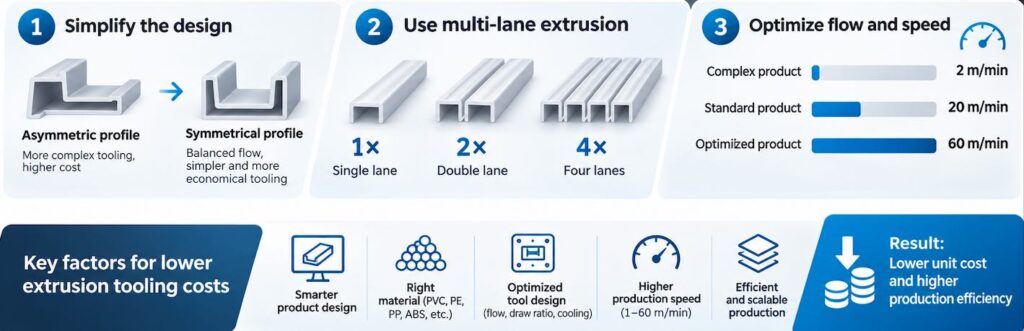
 English (UK)
 Slovenčina
 Deutsch
 Magyar
 Français
 Čeština
 Slovenščina
 Hrvatski
 Nederlands