
How Do You Design an Extrudable Plastic Profile? (Part 3)
The first two parts of this engineering guide introduced the fundamental principles of successful plastic profile design. We explored how profile geometry, material selection, manufacturing stability and production efficiency all contribute to creating a high-quality extrusion.
In this final part, we move beyond the basics and focus on the engineering decisions that distinguish an acceptable profile from an exceptional one. These are the considerations that help reduce development risks, improve long-term product performance and achieve more efficient, cost-effective manufacturing.
Whether you are designing a completely new profile or refining an existing product, the following recommendations are based on practical engineering experience gained from real-world extrusion projects across a wide range of industries.
Rule 13 – Can the Profile Be Inspected Easily?
A well-designed profile should not only be easy to manufacture—it should also be easy to inspect. If critical dimensions cannot be measured efficiently or defects are difficult to detect, maintaining consistent product quality becomes far more challenging.
Quality control begins long before production starts. During the design phase, engineers should consider how the finished profile will be measured, inspected and validated throughout manufacturing. Profiles that are difficult to inspect often require additional fixtures, longer inspection times or destructive testing, increasing production costs and reducing efficiency.
Designing for inspection helps manufacturers identify process deviations quickly, maintain tighter quality control and reduce the risk of defective products reaching customers.
What should be considered?
Critical dimensions and functional features should remain accessible throughout the inspection process. The easier a profile is to measure, the easier it is to maintain consistent quality during high-volume production.
- Ensure critical dimensions are accessible for measurement.
- Avoid hidden features that are difficult to inspect.
- Identify which dimensions are functionally critical.
- Consider optical measurement systems where appropriate.
- Design profiles that can be inspected consistently and repeatably.
- Reduce the need for complex inspection fixtures whenever possible.
✔ Practical Tip
Before approving a new profile, ask a simple question: "How will this be inspected on the production line?" If the answer is complicated, the profile design may benefit from further optimisation.
⚠ Common Design Mistake
Many profiles are designed without considering inspection requirements. As a result, manufacturers are forced to develop custom gauges or perform time-consuming manual measurements, increasing inspection costs throughout the product's lifetime.
Engineering Takeaway
Quality cannot be inspected into a product—it must be designed into it. Profiles that are easy to measure are easier to manufacture consistently and more economical to produce.
From Our Engineering Team
When reviewing a new profile, we identify the functional dimensions that must remain under tight process control. Designing these features to be easily accessible for measurement simplifies quality assurance, speeds up production checks and helps maintain consistent results throughout long production runs.
Rule 14 – Is the Profile Designed for High-Volume Production?
A profile that performs well during a short production trial may not necessarily perform equally well during continuous high-volume manufacturing. Designing for large-scale production requires engineers to consider process stability, automation and repeatability from the very beginning.
High-volume extrusion demands far more than dimensional accuracy. The profile must maintain consistent geometry over long production runs while moving through calibration, cooling, pulling, cutting and packaging without interruption. Even minor design features can influence production speed, scrap rates and overall equipment efficiency.
Designing for automation also reduces dependence on manual adjustments, helping manufacturers achieve more predictable quality and lower production costs.
What should be considered for large-scale production?
Profiles intended for serial production should support stable, repeatable manufacturing with minimal operator intervention.
- Stable profile geometry throughout long production runs.
- Consistent cooling behaviour across the entire cross-section.
- Compatibility with automated cutting and handling systems.
- Reliable dimensional control using inline measurement systems.
- Minimal need for manual process adjustments.
- Repeatable production across multiple manufacturing batches.
✔ Practical Tip
When developing a new profile, evaluate not only whether it can be manufactured, but also whether it can run efficiently for hours or even days without frequent machine adjustments. Long-term process stability is one of the strongest indicators of good extrusion design.
⚠ Common Design Mistake
Many new profiles are approved after a successful prototype run, without verifying how they behave during extended production. Small instabilities that seem insignificant during short trials can become major quality or productivity issues in high-volume manufacturing.
Engineering Takeaway
A profile designed for stable, automated production delivers more than consistent quality—it also improves productivity, reduces manufacturing costs and supports scalable growth as demand increases.
From Our Engineering Team
When reviewing new profile designs, we consider not only the first production trial but the thousands of metres that follow. Features that improve process stability, simplify automation and minimise operator intervention often provide the greatest long-term value for our customers.
Rule 15 – Can You Improve Sustainability Without Compromising Performance?
Sustainability has become an important consideration in modern product development. However, designing a sustainable plastic profile is not simply about using less material or selecting recycled polymers. The objective is to minimise environmental impact while maintaining the performance, durability and reliability required by the application.
A profile that fails prematurely is rarely sustainable, regardless of the material used. Extending product life, reducing waste and improving manufacturing efficiency often have a greater environmental benefit than focusing on material selection alone.
The most sustainable extrusion profiles are those that combine efficient material use, long service life and stable manufacturing with the ability to be recycled or reused whenever possible.
How can sustainability be improved?
Sustainable engineering should be considered throughout the entire product lifecycle—from raw material selection to manufacturing, transportation, use and end-of-life recycling.
- Reduce unnecessary material without sacrificing structural performance.
- Select materials appropriate for the product's expected service life.
- Design for long-term durability to minimise replacement.
- Optimise the profile for efficient manufacturing with minimal scrap.
- Consider recyclable or recycled materials where technically appropriate.
- Avoid unnecessary complexity that increases waste or processing time.
✔ Practical Tip
Evaluate sustainability using a life-cycle perspective rather than focusing on a single factor such as recycled content. A profile that performs reliably for many years often has a lower overall environmental impact than one that requires frequent replacement.
⚠ Common Design Mistake
A common misconception is that reducing material volume always makes a product more sustainable. If the profile becomes weaker, less durable or more difficult to manufacture, the overall environmental impact may actually increase due to higher waste, shorter service life or increased replacement rates.
Engineering Takeaway
Sustainable extrusion design is about achieving the right balance between material efficiency, manufacturing performance, durability and recyclability. The most environmentally responsible profile is often the one that performs reliably for the longest time with the least overall resource consumption.
From Our Engineering Team
When evaluating profile designs, we consider sustainability as part of the complete engineering process rather than a separate objective. Material optimisation, efficient production, reduced scrap and long product life frequently deliver greater environmental benefits than relying on a single sustainability measure. In our experience, the best solutions balance technical performance with responsible resource use.
Rule 15 – Can You Improve Sustainability Without Compromising Performance?
Sustainability has become an important consideration in modern product development. However, designing a sustainable plastic profile is not simply about using less material or selecting recycled polymers. The objective is to minimise environmental impact while maintaining the performance, durability and reliability required by the application.
A profile that fails prematurely is rarely sustainable, regardless of the material used. Extending product life, reducing waste and improving manufacturing efficiency often have a greater environmental benefit than focusing on material selection alone.
The most sustainable extrusion profiles are those that combine efficient material use, long service life and stable manufacturing with the ability to be recycled or reused whenever possible.
How can sustainability be improved?
Sustainable engineering should be considered throughout the entire product lifecycle—from raw material selection to manufacturing, transportation, use and end-of-life recycling.
- Reduce unnecessary material without sacrificing structural performance.
- Select materials appropriate for the product's expected service life.
- Design for long-term durability to minimise replacement.
- Optimise the profile for efficient manufacturing with minimal scrap.
- Consider recyclable or recycled materials where technically appropriate.
- Avoid unnecessary complexity that increases waste or processing time.
✔ Practical Tip
Evaluate sustainability using a life-cycle perspective rather than focusing on a single factor such as recycled content. A profile that performs reliably for many years often has a lower overall environmental impact than one that requires frequent replacement.
⚠ Common Design Mistake
A common misconception is that reducing material volume always makes a product more sustainable. If the profile becomes weaker, less durable or more difficult to manufacture, the overall environmental impact may actually increase due to higher waste, shorter service life or increased replacement rates.
Engineering Takeaway
Sustainable extrusion design is about achieving the right balance between material efficiency, manufacturing performance, durability and recyclability. The most environmentally responsible profile is often the one that performs reliably for the longest time with the least overall resource consumption.
From Our Engineering Team
When evaluating profile designs, we consider sustainability as part of the complete engineering process rather than a separate objective. Material optimisation, efficient production, reduced scrap and long product life frequently deliver greater environmental benefits than relying on a single sustainability measure. In our experience, the best solutions balance technical performance with responsible resource use.
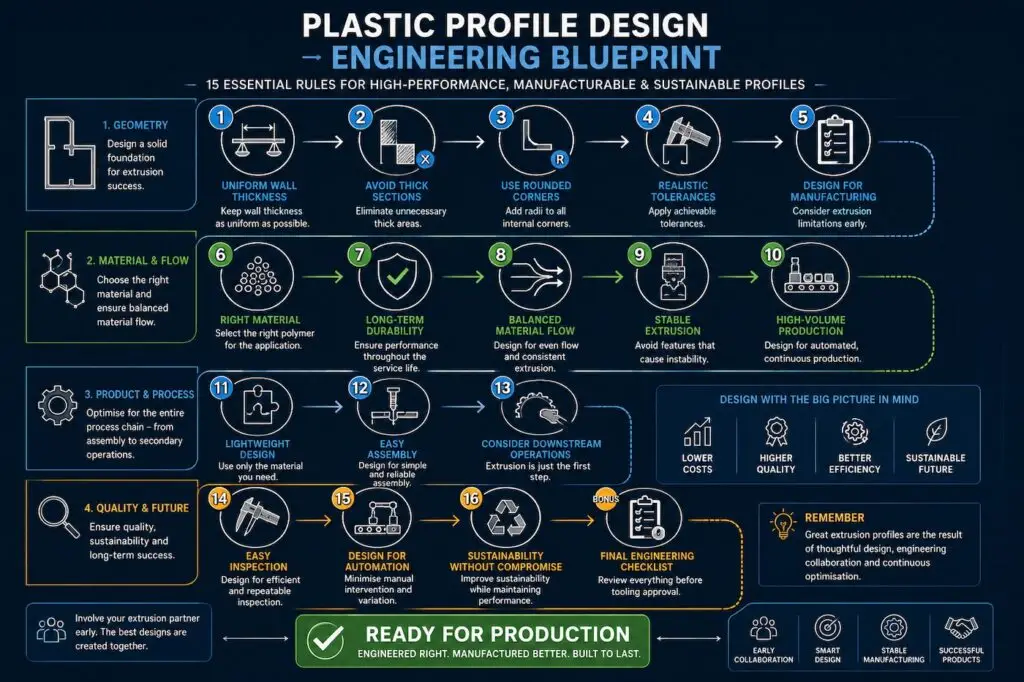
Thank You for Reading
If you've reached this point, you've completed all three parts of our engineering guide on designing extrudable plastic profiles. We sincerely appreciate the time you've invested in exploring these principles with us.
Every successful extrusion project starts with a simple idea, but turning that idea into a reliable, cost-effective and manufacturable product requires careful engineering. Throughout this guide, we've covered the most important considerations—from profile geometry and material selection to production stability, quality control and long-term performance.
While no two extrusion projects are ever identical, the engineering principles remain remarkably consistent. Profiles designed with manufacturing in mind are easier to produce, more reliable in service and ultimately more successful in the marketplace.
We hope this guide has provided practical knowledge that you can apply to your own projects, whether you are developing a completely new plastic profile or improving an existing design. If even one of these engineering rules helps you avoid a costly design revision or improve a product's performance, then this guide has achieved its purpose.
One Final Thought
Great extrusion profiles are rarely created by chance. They are the result of thoughtful engineering, practical experience, continuous optimisation and close collaboration between designers, material specialists and manufacturing engineers.
Thank You
Thank you for taking the time to read this three-part engineering guide. We hope it becomes a valuable reference throughout your future extrusion projects.
If you have questions about plastic profile design, material selection or extrusion manufacturing, our engineering team is always happy to exchange ideas and discuss technical challenges. Sharing engineering knowledge is one of the best ways to build better products.
We wish you every success with your next extrusion project.
 English (UK)
  Slovenčina
  Deutsch
  Magyar
  Français
  Čeština
  Slovenščina
  Hrvatski
  Nederlands