
How Plastic Extrusion Works
Plastic extrusion is one of the most efficient manufacturing technologies for producing continuous plastic profiles, tubes, seals and custom components. Discover the complete process, from raw material feeding to the finished product.
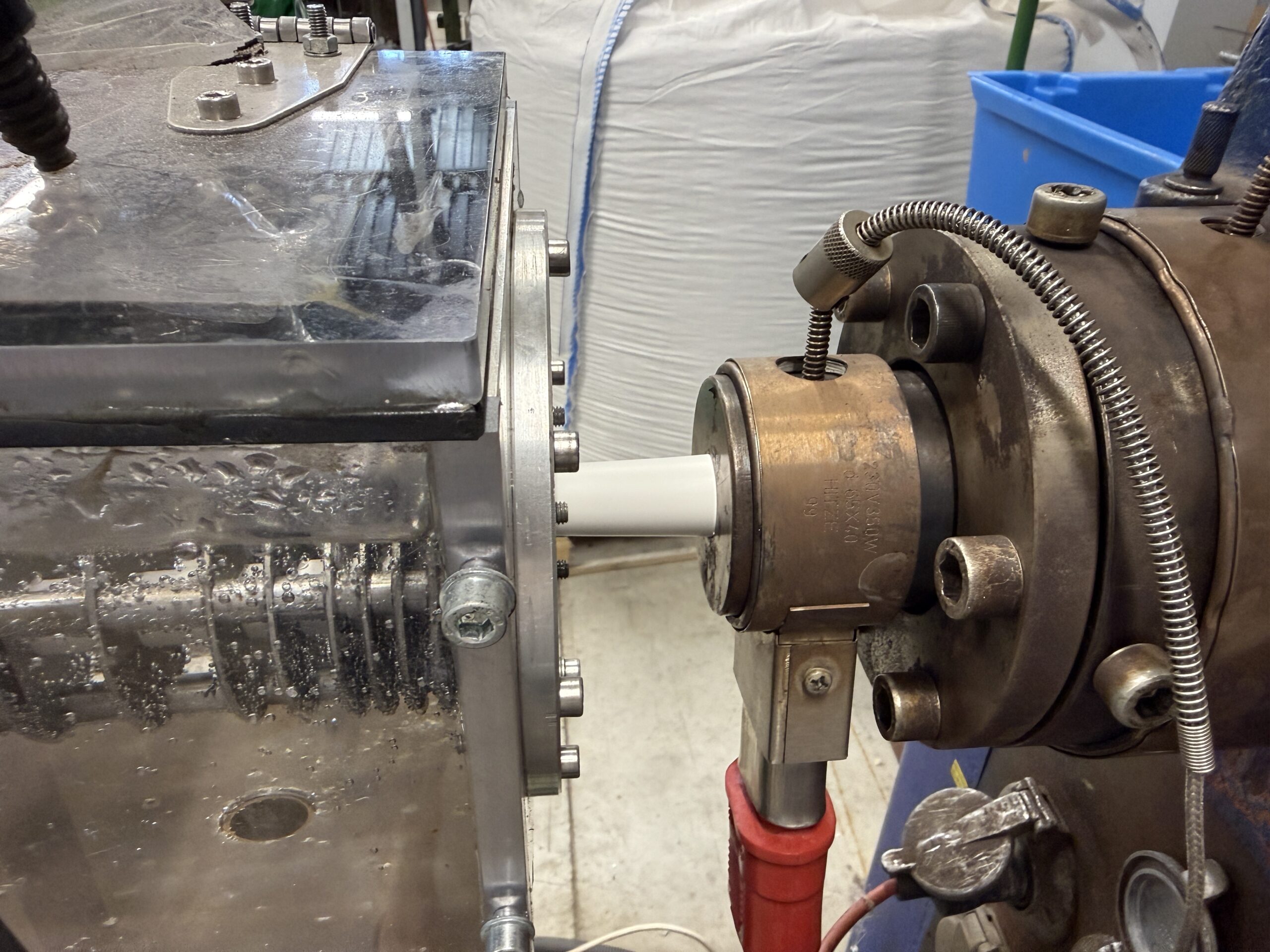
Plastic Extrusion Step by Step
From plastic pellets to finished products – every extrusion line follows the same fundamental manufacturing sequence.
Raw Material
Plastic pellets are fed into the hopper.
Extruder Screw
The screw transports, compresses and melts the material.
Heating Zones
Temperature is precisely controlled throughout the barrel.
Extrusion Die
The molten polymer receives its final cross-sectional shape.
Vacuum Calibration
Dimensions and surface quality are stabilized.
Cooling
Water or air cooling solidifies the product.
Quality Control
Laser measurement continuously checks tolerances.
Puller
The haul-off unit maintains constant production speed.
Cutting
The finished extrusion is cut or wound to the required length.
The Plastic Extrusion Process Explained
Plastic extrusion is a continuous manufacturing process in which raw plastic material is transformed into a product with a constant cross-section. Unlike injection moulding, where individual parts are produced in cycles, extrusion operates without interruption, making it one of the most efficient methods for manufacturing tubes, profiles, seals, rods, cable ducts and countless other plastic components.
The process begins with plastic pellets, which are automatically fed into the extruder through a hopper. Depending on the application, these pellets may consist of PVC, polyethylene (PE), polypropylene (PP), ABS, TPU or many other thermoplastic materials. Additives such as UV stabilisers, colour pigments, flame retardants or impact modifiers can also be blended into the material before processing to achieve specific mechanical or environmental properties.
Inside the extruder, a precisely engineered rotating screw conveys the material through several functional zones. As the pellets move forward, they are gradually compressed, heated and mixed into a homogeneous molten polymer. External heating elements work together with the friction generated by the rotating screw to ensure consistent melting and stable material flow.
Once the polymer reaches the required temperature and viscosity, it is forced through a precision-machined extrusion die. The die determines the final cross-sectional geometry of the product, whether it is a round tube, a complex technical profile or a custom-designed component. Because the material exits the die in a softened state, it cannot yet maintain its exact dimensions.
To achieve dimensional accuracy, the profile immediately enters a calibration system, which often uses vacuum technology to stabilise the product while preserving its shape. This stage is particularly critical for precision profiles and tubing, where even minor dimensional deviations can affect assembly, sealing performance or product functionality.
After calibration, the extrusion passes through a controlled cooling section. Depending on the material and product geometry, cooling may be performed using water baths, spray cooling or air cooling. Controlled cooling prevents deformation, minimises internal stresses and ensures consistent product quality throughout the production run.
Modern extrusion lines continuously monitor product dimensions using inline laser measuring systems and other quality control equipment. Diameter, wall thickness and profile dimensions are measured in real time, allowing the production line to automatically compensate for process variations before they develop into quality issues.
Finally, a haul-off unit pulls the profile through the complete production line at a constant speed, while an automated cutting or winding system prepares the finished product for packaging, further processing or immediate delivery. Because every stage is synchronised, modern extrusion lines are capable of producing thousands of metres of high-precision plastic products with exceptional repeatability and minimal material waste.
Common Materials Used in Plastic Extrusion
Every thermoplastic material has unique processing characteristics. Selecting the appropriate polymer depends on the required mechanical properties, temperature resistance, flexibility and the intended application.
PVC
| Processing Temperature | 160–190 °C |
| Density | 1.35–1.45 g/cm³ |
| Flexibility | Rigid / Flexible |
| Typical Products | Pipes, profiles, cable ducts |
PE (HDPE / LDPE)
| Processing Temperature | 180–230 °C |
| Density | 0.91–0.96 g/cm³ |
| Flexibility | Excellent |
| Typical Products | Tubes, hoses, protective profiles |
PP
| Processing Temperature | 190–240 °C |
| Density | 0.90–0.91 g/cm³ |
| Flexibility | Medium |
| Typical Products | Industrial profiles, containers |
ABS
| Processing Temperature | 210–250 °C |
| Density | 1.02–1.07 g/cm³ |
| Impact Resistance | Very High |
| Typical Products | Technical profiles, housings |
TPU
| Processing Temperature | 180–220 °C |
| Density | 1.10–1.25 g/cm³ |
| Elasticity | Excellent |
| Typical Products | Seals, flexible tubing |
ASA
| Processing Temperature | 220–260 °C |
| Density | 1.05–1.08 g/cm³ |
| UV Resistance | Excellent |
| Typical Products | Outdoor profiles, construction |
Plastic Extrusion: Precision Through Continuous Manufacturing
Plastic extrusion is one of the most versatile and efficient manufacturing technologies available today. By combining carefully selected raw materials, precision-engineered tooling and advanced process control, manufacturers can produce complex plastic profiles with exceptional dimensional accuracy, repeatability and cost efficiency.
Modern extrusion lines integrate automated material handling, intelligent temperature control, inline quality inspection and high-speed production, ensuring consistent product quality across short and long production runs. This combination of flexibility and precision makes extrusion the preferred manufacturing process for industries ranging from construction and automotive to electronics, medical devices and consumer products.
 English (UK)
  Slovenčina
  Deutsch
  Magyar
  Français
  Čeština
  Slovenščina
  Hrvatski
  Nederlands