
What Is Plastic Extrusion?
Plastic extrusion is one of the most efficient and widely used manufacturing processes for producing continuous plastic products with a constant cross-section along their entire length. Unlike injection molding, extrusion is a continuous production method, making it ideal for manufacturing long products that require consistent dimensions and high repeatability.
During the extrusion process, molten plastic is forced through a specially designed die, which determines the shape of the final product. Because the profile remains identical from beginning to end, extrusion is perfectly suited for manufacturing products such as plastic pipes, protective conduits, technical profiles, sealing profiles, tubes, and cable ducts.
One of the greatest advantages of plastic extrusion is that there is virtually no practical limit to the product length. For example, HDPE protective conduits (Symalen™ pipes) can be produced in continuous lengths of hundreds of meters or even several kilometers before being cut or wound into coils according to customer requirements. This makes extrusion the preferred manufacturing technology whenever long, lightweight, and dimensionally consistent plastic products are needed.
Thanks to its high efficiency, excellent dimensional accuracy, and cost-effective continuous production, plastic extrusion is widely used in industries including construction, electrical engineering, automotive, lighting, medical devices, and industrial manufacturing.
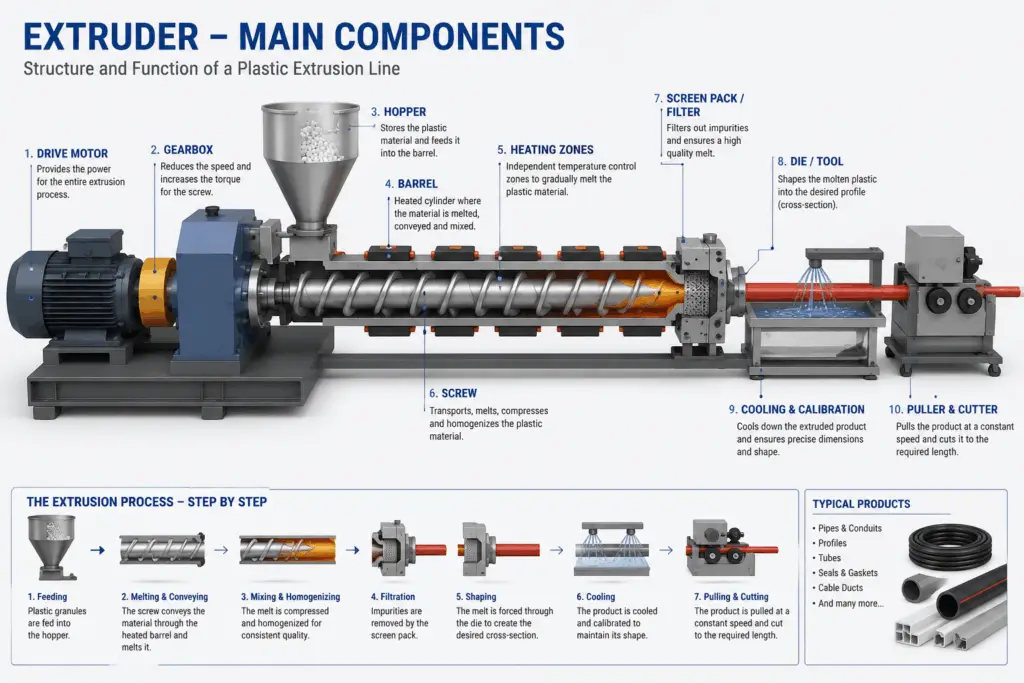
Inside the extruder, the rotating screw melts and homogenizes the plastic material before forcing it through a precision die that forms the final cross-section. The extruded product is then cooled and calibrated to maintain its exact dimensions, resulting in a high-quality plastic pipe or profile ready for cutting or coiling.
Products Manufactured by Plastic Extrusion
Plastic extrusion is a highly versatile manufacturing process capable of producing a wide variety of continuous plastic products with consistent cross-sections. Typical extruded products include:
What Materials Can Be Processed by Plastic Extrusion?
Plastic extrusion is compatible with most thermoplastic materials, making it one of the most versatile manufacturing processes available. Depending on the application, manufacturers can select from a wide range of commodity and engineering plastics with different mechanical, thermal, and chemical properties.
The final material selection depends on the required mechanical strength, flexibility, chemical resistance, UV stability, operating temperature, and the intended application of the finished extruded product.
Advantages of Plastic Extrusion
Plastic extrusion offers an efficient and cost-effective manufacturing solution for producing continuous plastic products with consistent quality. Its flexibility and scalability make it the preferred process for a wide range of industrial applications.
Continuous Production
High production speeds enable efficient, uninterrupted manufacturing for large-volume orders.
Precision & Consistency
Advanced extrusion lines deliver excellent dimensional accuracy and repeatable product quality.
Custom Profile Design
Complex cross-sections can be manufactured to meet unique customer specifications.
Material Flexibility
Suitable for processing most thermoplastics, from standard polymers to engineering-grade materials.
Lower Production Costs
Continuous manufacturing minimizes waste and reduces the cost per part in medium and high production volumes.
Fully Customizable
Products can be manufactured in custom colors, dimensions, wall thicknesses, and performance characteristics.
Whether producing plastic pipes, technical profiles, protective conduits, or co-extruded components, plastic extrusion provides an excellent balance of quality, flexibility, and manufacturing efficiency for modern industrial applications.
Industries That Use Plastic Extrusion
Plastic extrusion is a key manufacturing process used across numerous industries. Its ability to produce durable, lightweight, and cost-effective components makes it suitable for a wide variety of industrial and commercial applications.
Why Choosing the Right Extrusion Manufacturer Matters
The quality of an extruded plastic product depends on much more than the raw material itself. Tool design, extrusion technology, process control, and quality assurance all play a critical role in achieving consistent results. An experienced extrusion manufacturer can maintain tight dimensional tolerances, ensure repeatable product quality, and develop custom solutions tailored to specific technical and application requirements. From prototype development to high-volume production, selecting the right manufacturing partner helps reduce costs, improve performance, and ensure long-term reliability.
Conclusion
Plastic extrusion is one of the most efficient and versatile manufacturing processes for producing continuous plastic products with consistent quality and precision. Whether manufacturing pipes, technical profiles, protective conduits, or custom-engineered components, the process offers excellent flexibility, cost efficiency, and scalability for a wide range of industries.
By combining advanced extrusion technology, precision tooling, high-quality thermoplastic materials, and rigorous quality control, manufacturers can produce durable products that meet demanding technical specifications. As industries continue to require lightweight, reliable, and cost-effective plastic components, plastic extrusion remains one of the most important manufacturing technologies in modern industrial production.
 English (UK)
  Slovenčina
  Deutsch
  Magyar
  Français
  Čeština
  Slovenščina
  Hrvatski
  Nederlands